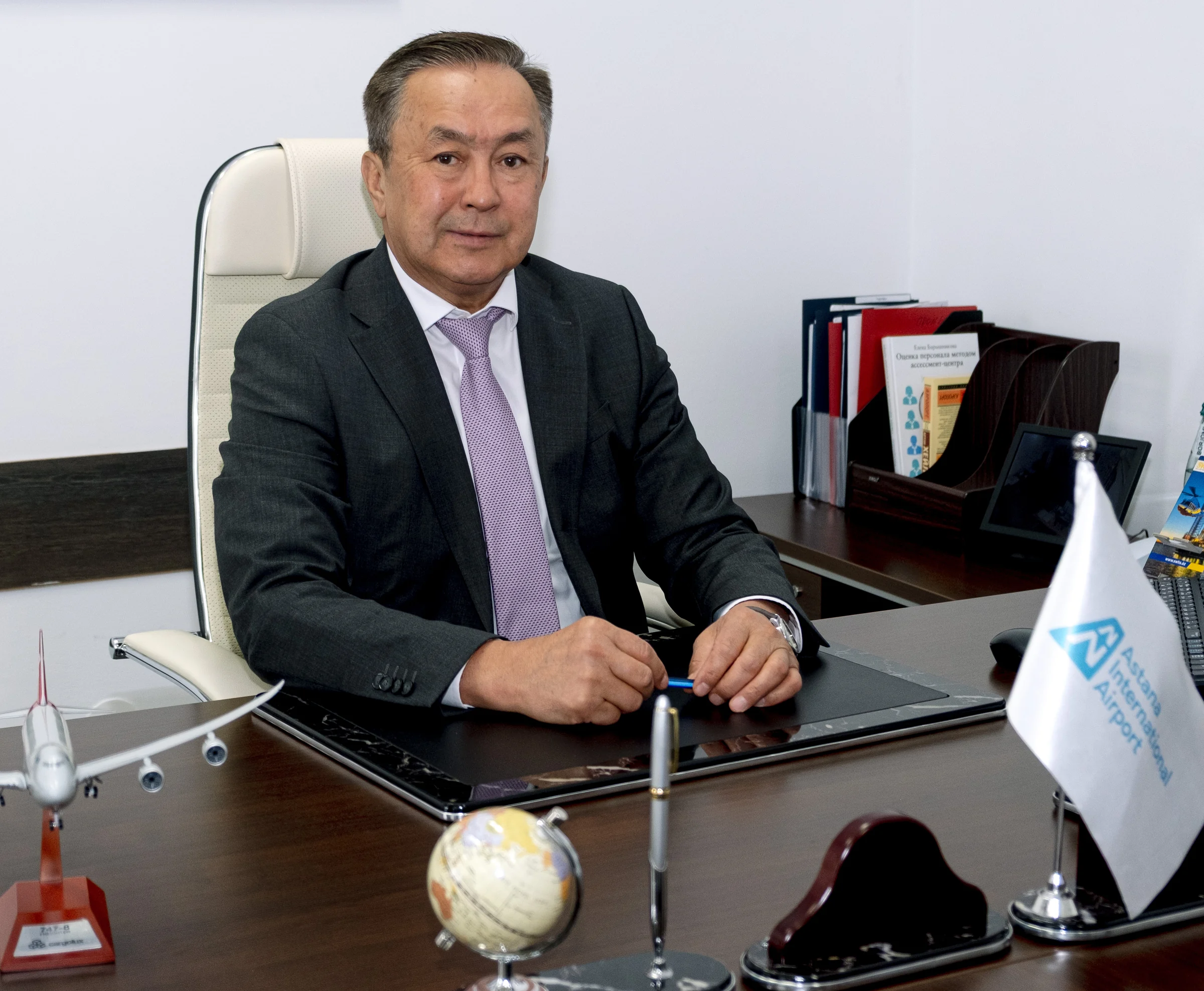
— Beken Kanelovich, Astana Airport is celebrating its 95th anniversary. How do you envision the next chapter in its history?
— Ninety-five years is a significant milestone that reflects an extraordinary journey. But for us, this anniversary is not only an opportunity to look back. It is important to understand what the airport should become in ten or twenty years. Today, we are gradually changing our entire approach to its development. An airport can no longer be viewed solely as a place passengers come to in order to fly somewhere, or where their journey ends.
The world’s largest airports have long been centers of economic activity. Hotels, business centers, logistics complexes, retail and service infrastructure, and industrial sites have developed around them. This is the essence of the aerotropolis concept that we are considering for Astana. Our goal is to transition from an “airport as infrastructure” model to an “airport as a driver of the city’s economic growth” model.
— Why does Astana in particular have the potential to develop such an aerotropolis?
— One of our main advantages is our geographic location. Astana lies between the largest markets of Europe and Asia and can develop as a hub along two axes: East–West and North–South. Therefore, this is not simply about launching new flights, but about creating a full-fledged connecting-flight model that allows passengers to continue their journeys conveniently through Astana.
By 2029, the airport’s target passenger traffic is approximately 14.8 million passengers per year, while the transit share is planned to reach 15%—approximately 2.2 million passengers.
In the long term, terminal infrastructure capacity could be increased to 20 million passengers per year. Infrastructure must therefore be designed today with future growth in mind.
— Is an aerotropolis only about passenger transport?
— No. Cargo logistics is a very important part of this model. Astana has the potential to become not only a passenger hub but also a full-fledged cargo and multimodal hub. In the future, air transport should be integrated with rail and road transport. This will enable us to make more effective use of the capital’s geographic location and develop new lines of business around the airport.
The aerotropolis as a whole should become an economic ecosystem. It encompasses investment, logistics, the hotel business, commercial facilities, jobs, taxes, and new opportunities for entrepreneurs. At the same time, this does not mean unplanned development of the area around the airport. All facilities should be developed as parts of a unified model and linked by a shared approach to development.
— As a result of all these changes, what should the average passenger experience?
— First and foremost, comfort and simplicity. Four principles are important to us here: speed, simplicity, accessibility, and comfort. Passengers do not need to know how many complex systems operate behind the scenes. What matters to them is being able to reach the airport quickly, complete check-in and security screening easily, receive clear information, and wait comfortably for their flight. That is why large-scale infrastructure development must proceed in parallel with improvements to the everyday passenger experience.
— What would you like Astana Airport to look like in the future?
— It should be a strong international hub with an extensive route network, convenient connections, modern infrastructure, and substantial cargo potential. A business and logistics ecosystem—a full-fledged aerotropolis—should develop around it.
For an airport with a 95-year history, this will mark the beginning of an entirely new chapter. The airport should serve not only aviation but also Astana and the entire country—attracting airlines, passengers, cargo, international business, and investment, and becoming one of the drivers of the city’s economy. This is how we want Astana International Airport to develop in the future.