The largest project pipeline is in logistics and warehousing, with about 70 projects. Industry accounts for approximately another 50 projects, education for 45, sports and tourism for 32, and healthcare for 18.
For Astana, however, it is not only the volume of capital attracted that matters, but also the gradual transformation of its structure. The focus is shifting toward the non-resource sector and higher value-added production.
Private capital becomes a growth driver
Investment activity in the capital continues to grow. The contribution from businesses is particularly noteworthy: private investment reached 926.6 billion tenge, with a physical volume index of 111.3%. Private capital is therefore becoming one of the key drivers of the city’s investment growth.
The next task is to accelerate major manufacturing projects, expand the participation of foreign investors, and further develop industrial and logistics infrastructure.
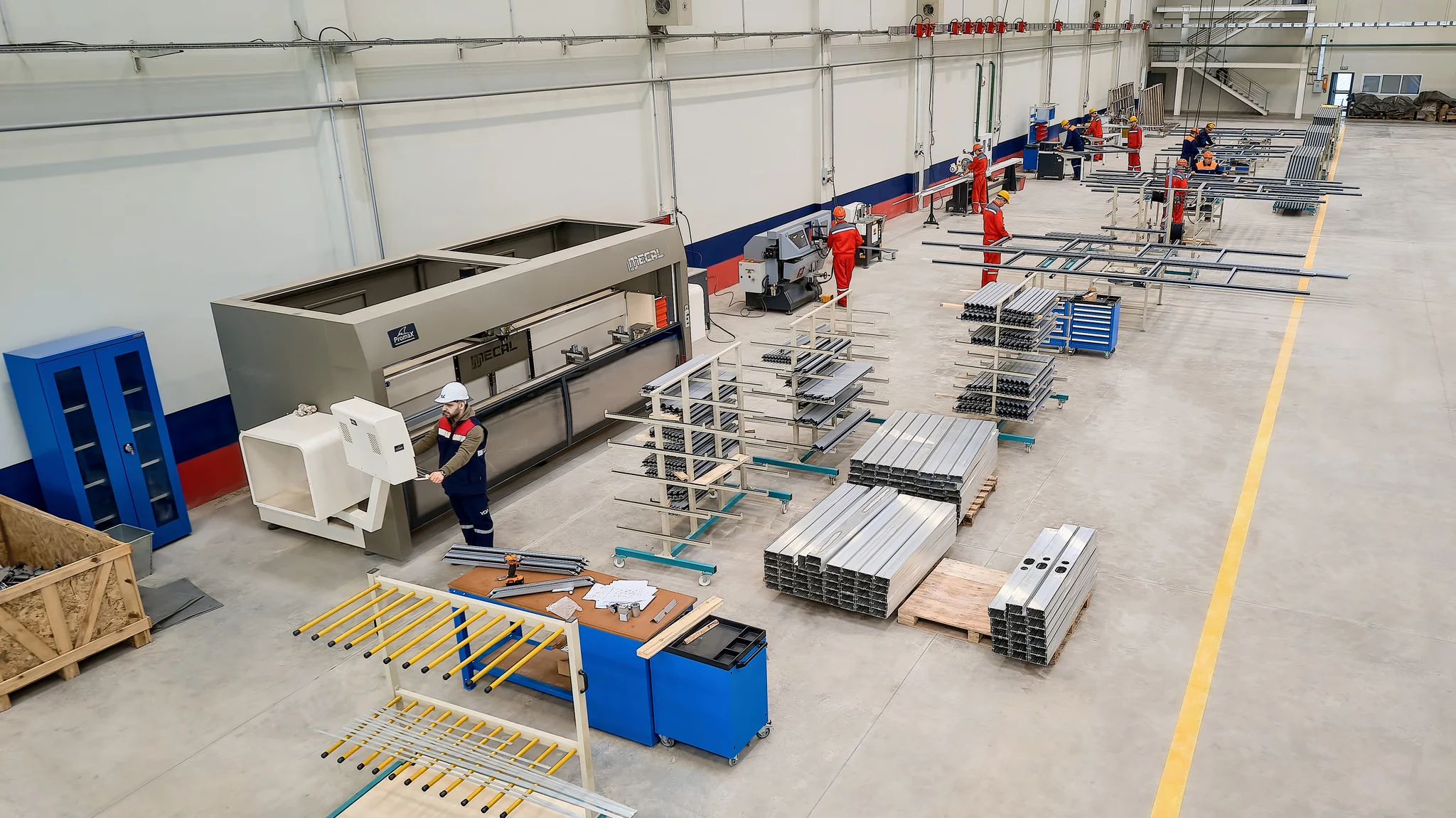
For the capital, this means a gradual transition to a more diversified economic model. Projects are underway in the city to manufacture building materials, reinforced-concrete products, metal-plastic structures, medical devices, tubular products, and heat-generating units.
Modern warehousing and distribution infrastructure is also being developed. This is laying the groundwork not only for domestic trade, but also for e-commerce, transport services, and the expansion of international trade links.
A New Industrial Landscape
Industrial Park No. 2 is expected to become one of the key elements of this strategy.
Plans call for more than 100 projects with a total value of about 500 billion tenge to be located there, creating approximately 8,000 jobs. A pipeline of 30 projects worth more than 250 billion tenge has already been assembled.
Priority is being given to mechanical engineering, the food and light industries, the production of building materials and furniture, the medical sector, and infrastructure projects.
However, the significance of the new site is expected to extend beyond merely accommodating manufacturing facilities. The aim is to develop local supplier chains around major enterprises and support the growth of small and medium-sized businesses.
The goal, therefore, is to create a fully developed industrial ecosystem in which investment by one major enterprise can generate additional demand for the products and services of dozens of local companies.
Foreign capital: a focus on trust and diversification
Attracting international capital remains a separate priority. According to the city administration, foreign direct investment inflows into Astana exceeded $4 billion in 2025.
The capital already has experience implementing projects with investors from Türkiye, China, the UAE, Russia, France, Japan, Germany, and Austria.
The city considers Astana’s competitive advantage to be its combination of several factors: its status as the country’s administrative and business center, modern infrastructure, transport and logistics potential, and diversified economy.
At the same time, potential for further growth remains. Key objectives include accelerating the implementation of major investment projects, expanding the presence of foreign investors, and increasing the number of high value-added production facilities with export potential.
To this end, the city is developing new investment sites and industrial infrastructure, while also supporting projects at various stages of implementation.
Astana 2030: Investment must benefit the city’s economy
By 2030, Astana aims to establish itself as one of the region’s leading investment, business, industrial, and transport and logistics centers. However, the volume of capital attracted should not be the only measure of success.
Investment must translate into new jobs, growth in industrial production, localization, the development of local supplier chains, increased tax revenues, and improvements in the quality of urban infrastructure.
In the longer term, the aim is to create an investment ecosystem in the capital where international and Kazakhstani investors will engage with local businesses, industrial enterprises, logistics operators, and technology companies.
This approach could become the next stage in the evolution of Astana’s investment profile: shifting from increasing the volume of investment to improving the quality of investment and its impact on the city’s economy.