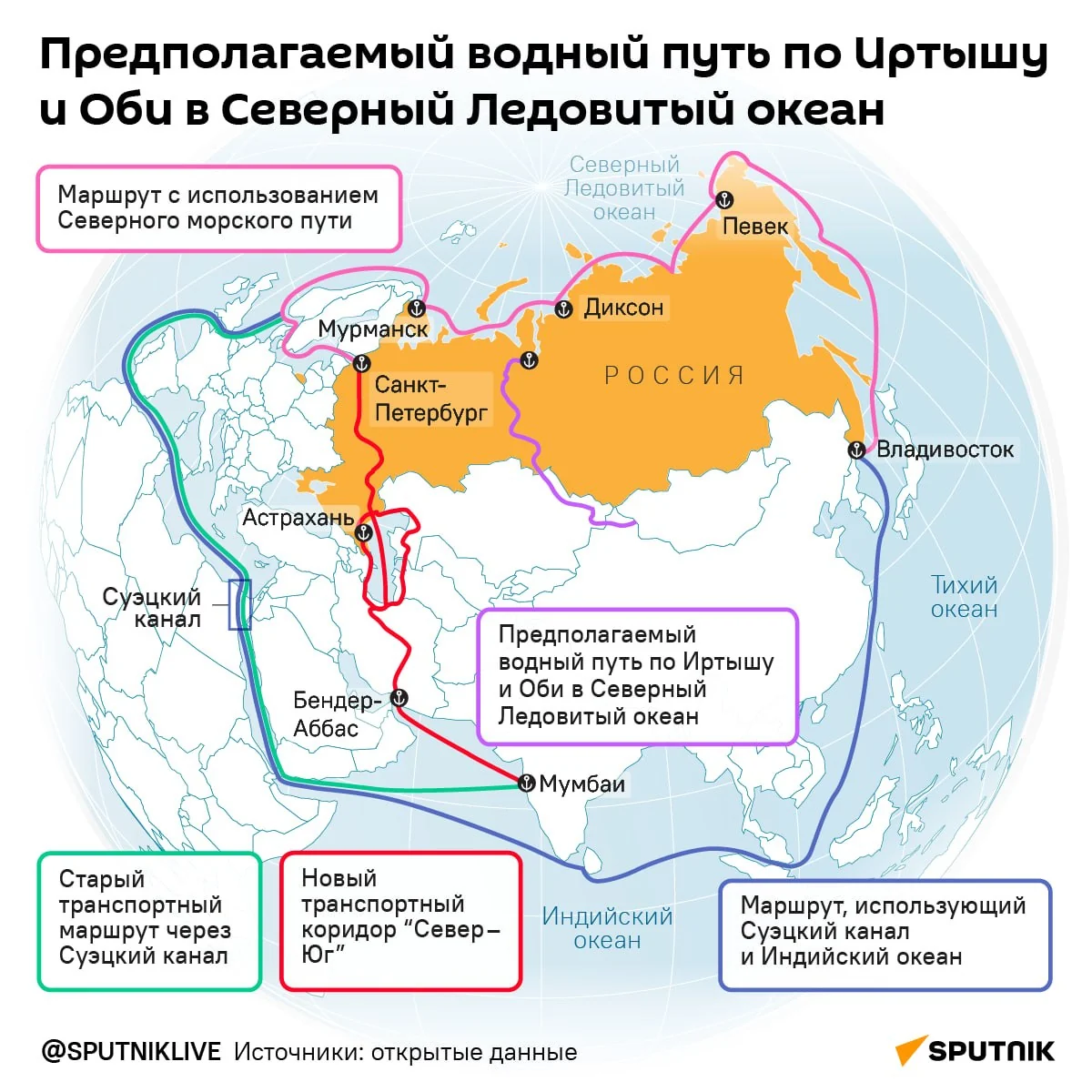
Chinese vessels’ access to the Northern Sea Route currently depends on the Bering Strait. At its narrowest point, it is about 85 km wide, and the United States could block it from Alaska, SCMP writes. “If China wants guaranteed access to the Arctic Ocean, it needs to resolve the Bering Strait dilemma. A corridor along the Irtysh River is one obvious solution,” said Artyom Lukin, a professor at Far Eastern Federal University. Zhao Long added that developing the Irtysh River makes sense as a fallback option in the event that the strait is blocked.
The Irtysh River flows through three countries: China, Kazakhstan, and Russia. The river has a total length of about 4,248 km, approximately 2,000 km of which is in Russian territory.
Kazakhstan has long promoted the Ob–Irtysh transport system. In 2024, the country presented a specific plan, and Russia incorporated it into the Trans-Arctic Transport Corridor. Russian President Vladimir Putin has said that Moscow and Astana are seeking “a balanced approach to increasing freight traffic, developing water resources and preserving the river ecosystem.” No official statements have yet been made by the Chinese government.
The project also faces serious obstacles, the newspaper notes. The Irtysh River freezes for up to six months of the year, while siltation periodically necessitates large-scale dredging. “Total costs could amount to tens or even hundreds of billions of dollars. Implementing the Irtysh River project requires an entirely new level of mutual trust and closer relations between China, Russia, and Kazakhstan,” Lukin said.
At an SCO event in 2024, Andrey Tarasenko, head of the Federal Agency for Maritime and River Transport, said that total freight volume in the Ob–Irtysh basin reaches 12 million tonnes. According to him, minimum navigable channel depths range from 150 to 300 cm across different sections, about 370 vessels operated in the basin, and port infrastructure is already developed.
He also noted the need to ship mineral fertilisers and grain to China, while vessels could carry cargo on return voyages. Tarasenko said that launching full-scale logistics operations would require a trilateral agreement among Russia, Kazakhstan, and the People’s Republic of China. Preliminary talks had already been held with both sides, and China had expressed interest, he noted.
State Atomic Energy Corporation Rosatom previously granted the Chinese logistics company Sea Legend Shipping permission to transit the Northern Sea Route through Arctic waters. “Unlike previous container shipping operations, which were largely experimental or one-off in nature, the 2026 programme provides for a fully fledged regular liner service, with vessels departing weekly during the navigation season,” Alexey Likhachev, head of the state corporation, said at the time.
Source: https://finance.mail.ru/article/irtysh-pomozhet-kitayu-reshit-dilemmu-beringova-proliva-69225162/