In Step with Aviation
Growth in air transport is increasing the workload for ground services, including catering providers. According to the Aviation Administration of Kazakhstan, the country’s airports handled 31.8 million passengers in 2025, while Kazakhstan’s airlines carried 15.4 million passengers.
QCS serves more than ten airlines, and its services reach over two million air passengers each year. Its partners include Air Astana, FlyArystan, Air China, LOT Polish Airlines, and Vietjet Qazaqstan. The company also reports that it works with Berkut and has experience serving special state flights. Different types of air transport require tailored solutions, but the overall task remains the same: to prepare in-flight meals to the agreed specification and deliver them to the aircraft on time.
From Raw Materials to the Aircraft
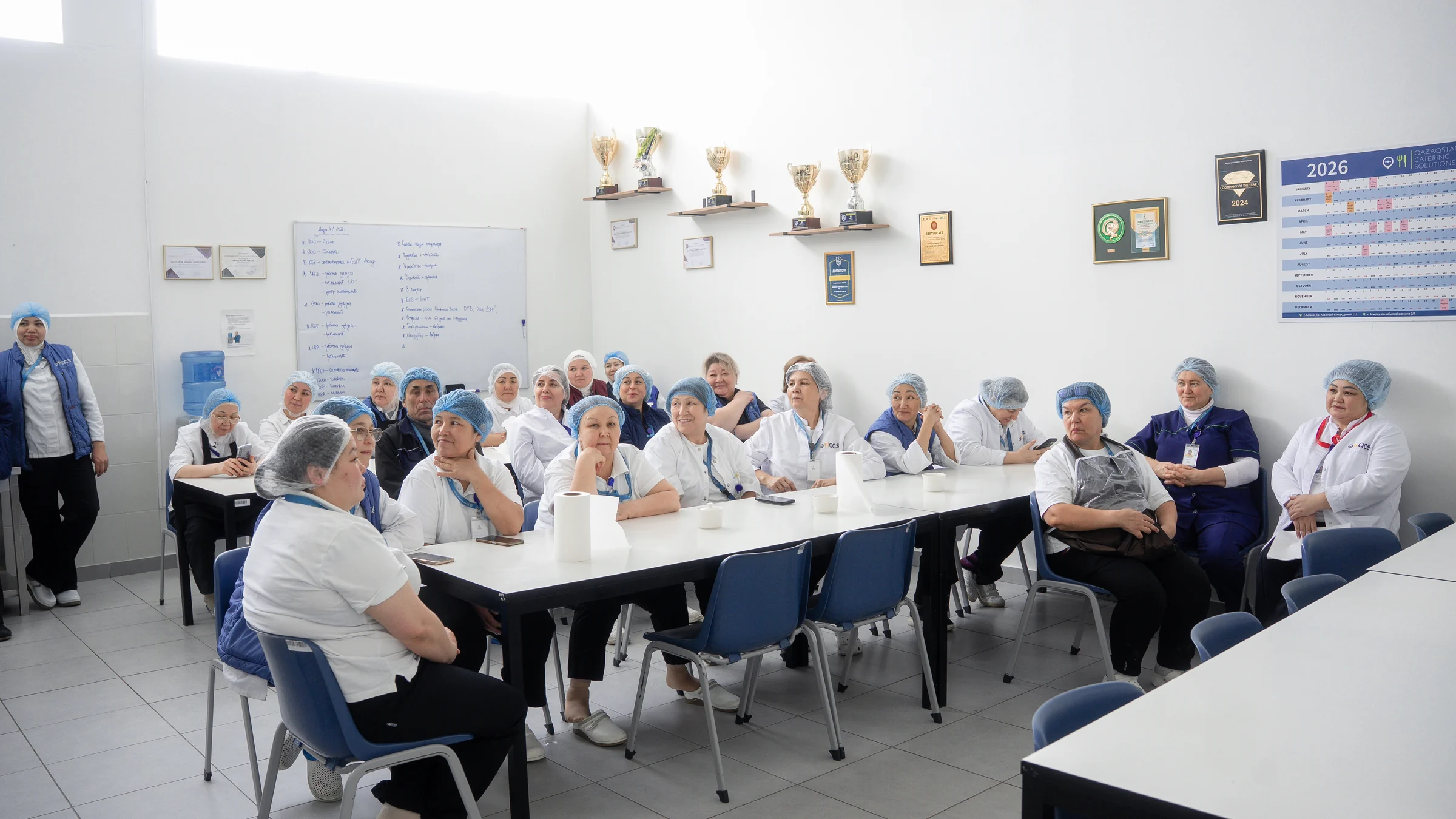
QCS’s main production facility is located near Astana Airport. The site covers about 3,000 square meters. It handles the entire operating cycle: receipt and storage of raw materials, food preparation, meal assembly, and the transfer of finished products for delivery. The production operation includes hot and cold kitchens, a pastry section, and a meal assembly area.
In-flight meals require precision even in the smallest details of presentation. “Everything here is strictly regulated: where the bread roll, plate, and cheese must be placed,” explains QCS Chief Executive Officer Didar Shaukharov. For the production team, this means consistently reproducing the agreed result in every meal portion.
Quality control begins before products reach the kitchen: incoming products undergo aviation security screening and quality checks. According to the company, its processes are based on HACCP principles and the ISO 22000 standard, while internal audits cover various stages of production. The FIFO principle is also applied: raw materials received earlier are used in production first.
Delivery is handled by the operations service, which includes a round-the-clock dispatch center. It coordinates the kitchen, meal assembly, and transportation with flight schedules. According to QCS, catering delivery agents use body-worn video recorders, catering high-loaders are equipped with cameras, and vehicles have GPS trackers. This ensures that products remain under control beyond the production area, right through to handover to the customer.
Kazakh Cuisine at Altitude
One notable QCS project was the spring 2026 launch of Air Astana’s new menu in partnership with the Sandyq restaurant. It is an example of a collaboration in which a restaurant concept is adapted to meet aviation service requirements.
According to Forbes Kazakhstan, the menu unveiled for Nauryz included Kazakh-style meat, būqpa, and Qymyz qabyrğa—lamb ribs marinated in kumis. For passengers, these dishes offer an introduction to Kazakh gastronomy; for the producer, they present an interesting challenge in preserving flavor and presentation during large-scale production.
The striking presentation is the result of collaboration among chefs, food technologists, and airline representatives. Meal portion size, assembly, and in-flight service conditions must all be taken into account. This is where catering expertise makes it possible to turn a signature menu into a regular service. For an international visitor, Kazakh cuisine served on an aircraft may be one of their first impressions of Kazakhstan.
Lunch Timed to Shifts
QCS’s second major line of business is industrial catering. Its customers include Qarmet and Stadler Kazakhstan. At Qarmet-Orken sites, its operations cover Atansor, Kentobe, and Atasu, among other locations, where the team provides catering for employees of mining companies.
This area has its own operating rhythm: service must be coordinated with shifts and breaks, while supplies must be planned around the site’s location. At a remote site, regular deliveries, adequate food stocks, and consistent meal quality are particularly important. Here, culinary work is inseparable from warehouse management, logistics, and the allocation of responsibilities.
By outsourcing catering to a specialist operator, an industrial business can focus on its core production activities. At the same time, service quality is determined by very specific factors: the availability of a hot lunch, adherence to the schedule, and compliance with safety requirements. For QCS, industrial projects broaden its customer base and enable it to apply its large-scale food production experience in a different production environment.
A Regional Network and In-house Projects
QCS operates in Astana, Atyrau, Oral, and Karaganda operations. Its operating formats vary: in-flight catering, catering at industrial sites, and cafes. In July 2026, the Atyrau kitchen produced an average of 749 meal portions per day for passengers and crew, while the Oral branch served 40 flights operated by SCAT Airlines and FlyArystan.
At the same time, QCS is developing Aspan Food, Aspan Cafe, and the Sky Bar in-flight retail offering. The company’s portfolio includes food outlets for passengers and airport employees, as well as solutions for selling products on board in accordance with air carrier requirements.
These projects complement the contract catering business by providing direct, daily insight into consumer demand. At cafes, customers choose their own dishes, while onboard sales depend on the product range and convenience of service. For QCS, this is an opportunity to use its production base in several formats and gain a better understanding of end customers’ preferences.
Growth Starts with Processes
Expanding the network requires coordinated work among chefs, food technologists, dispatchers, drivers, and service staff. At QCS, this expertise is complemented by the training of future professionals: the company offers students practical training and internships that allow them to learn how production is organized.
In 2026, QCS implemented the Clockster digital workforce management system and updated its procurement procedures. For a growing company, such changes help streamline the day-to-day work of its divisions. Training, clear operating procedures, and performance monitoring become particularly important when customers and production sites are located in different regions.
The history of QCS shows how a specialized service business is developing around aviation and industry. Its resilience depends on the ability to combine culinary expertise with production discipline. For an air passenger or industrial employee, the outcome looks simple—a quality meal received on time. For the operator, it involves an entire chain of decisions, from selecting a supplier to the final inspection before the meal is handed over.