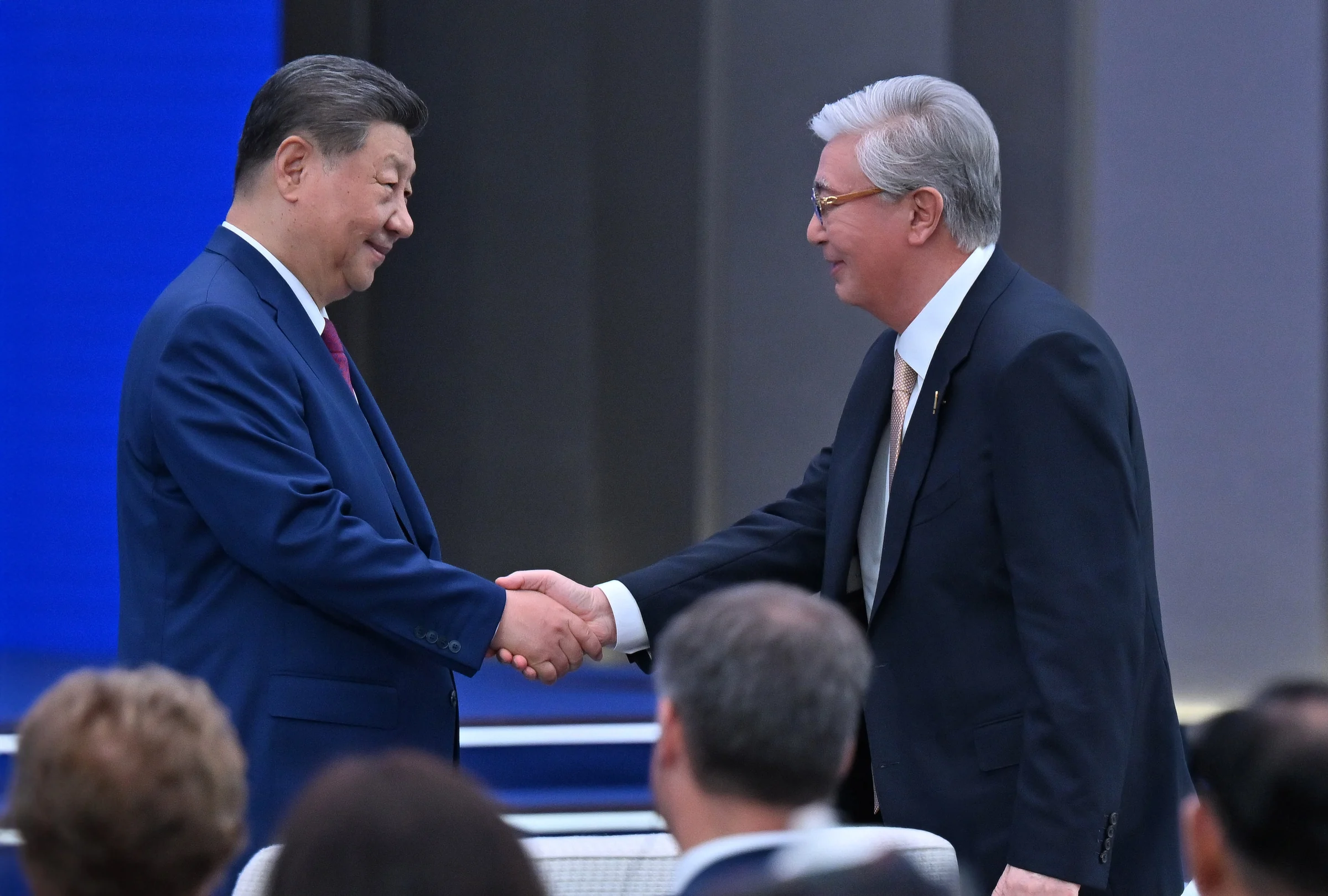
The meetings with Chinese businesses resulted in the signing of more than 70 commercial documents worth over $15 billion. They cover artificial intelligence and digitization, transport, energy, industry, finance, agriculture, and other areas.
The existing foundation for cooperation is already substantial. China has invested more than $30 billion in Kazakhstan’s economy, more than 8,500 Chinese-invested enterprises operate in the country, and bilateral trade reached a record $49 billion in 2025.
From Capital to Technology
The key change lies in the nature of investment projects. While Kazakhstan–China economic cooperation was previously associated largely with raw materials and infrastructure, projects involving deep processing, mechanical engineering, battery technology, artificial intelligence, and digital infrastructure are now becoming increasingly prominent.
One example is the talks with CATL, one of the world’s largest battery manufacturers, on the potential construction of a battery cell plant in Kazakhstan. Such a project could create a new industrial chain around it, spanning component manufacturing, energy storage systems, and electric transport.
Kazakhstan is discussing projects with Xiaomi Corporation in artificial intelligence, big data, cloud technology, and digital platforms, as well as cooperation involving electric vehicles and intelligent transport systems.
Manufacturing localization is also continuing in the automotive industry. Vehicles from several Chinese brands are already produced in Kazakhstan, and new agreements were reached during the visit, including on the production of Li Auto, OMODA, and JAECOO vehicles.
Kazakhstan is therefore offering investors not only a domestic market, but also a manufacturing base with the potential for subsequent access to the markets of Central Asia and Eurasia.
Geography as an Investment Asset
Another advantage of Kazakhstan is its location between the major markets of China and Europe. A total of 13 international transport corridors cross the country, while approximately 85% of rail shipments between China and Europe pass through Kazakhstan. More than $35 billion has been invested in developing the country’s transport and logistics infrastructure over the past 15 years.
The task now is to transform this transit advantage into a broader investment ecosystem.
Major infrastructure projects are being discussed with China Communications Construction Company Limited, including the construction of the Bakhty–Ayagoz railway line. The Trans-Caspian International Transport Route is also being developed, with new projects including a multimodal port hub and terminal infrastructure at the Port of Kuryk.
Digital infrastructure is being added to physical infrastructure. Smart Cargo is intended to integrate customs, logistics, and commercial services, creating a more transparent and user-friendly environment for freight transportation.
Energy for the Artificial Intelligence Economy
A separate area of focus is leveraging Kazakhstan’s energy potential to attract investment in digital infrastructure.
The global growth of artificial intelligence is sharply increasing demand for computing capacity, data centers, and electricity. Kazakhstan is seeking to capitalize on this window of opportunity through the Data Center Valley project in Ekibastuz.
The project envisions creating an international hub for data centers, cloud services, and AI infrastructure. Investors are expected to be offered prepared sites, modern infrastructure, a stable power supply, and a dedicated investment regime.
A broader ecosystem should emerge around data centers, including supercomputing capacity, AI laboratories, research centers, educational programs, startups, and digital services exports.
Kassym-Jomart Tokayev called Data Center Valley “a key pillar of the digital infrastructure of Kazakhstan and Central Asia as a whole.”
At the World Artificial Intelligence Conference, the President of Kazakhstan also raised the issue of countries’ access to the new technology economy:
“Every state must have the opportunity to develop its own human capital, digital infrastructure, and institutional capacity.”
This point is particularly important to Kazakhstan’s positioning as an investment destination. The country seeks to be not only a consumer of foreign technology, but also a platform where the necessary infrastructure is built and a domestic technology ecosystem takes shape.
A Digital Bridge Between Kazakhstan and China
Another element of this strategy was the Kazakhstan–China Digital Bridge initiative proposed by Kassym-Jomart Tokayev in Shanghai: “We propose launching the Kazakhstan–China Digital Bridge initiative, whose primary goal is to stimulate the development of digital trade and create a practical model for integrating digital economies under the Belt and Road Initiative,” he said.
Essentially, this involves extending the logic of a traditional transit corridor into the digital realm. Kazakhstan seeks to leverage its position between China and Europe not only to move physical cargo, but also to develop digital trade, data infrastructure, and technological cooperation.
The President of Kazakhstan also identified the sectors in which Kazakhstan is interested in the large-scale adoption of new technologies: manufacturing and mining, energy, agriculture, healthcare, and water-resource management.
Artificial intelligence is therefore viewed not as a separate IT sector, but as a tool for modernizing virtually the entire economy.
Alatau: A Proposition for Global Investors
Another potential investment destination is Alatau City. The project is being developed according to the Digital by Default principle and calls for the advancement of Smart City technologies, intelligent transportation, digital payments, and modern telecommunications infrastructure. However, the proposed special regulatory environment is no less important to investors. The project provides for a special legal regime and opportunities to develop digital assets, blockchain, tokenization, and other emerging industries.
An additional instrument is the Astana International Financial Centre (AIFC), which operates on the principles of English common law and brings together approximately 6,000 companies from more than 90 countries.
In this way, Kazakhstan is seeking to compete for technology investments not only through its resources and geography, but also through its business environment.
A New Investment Formula
The main outcome of the visit to China lies not only in the number of agreements or their stated value. Kazakhstan’s expectations of foreign capital are themselves changing. The country needs investments that establish manufacturing operations, transfer technology, develop human capital, and integrate Kazakhstani enterprises into international value chains.
This is precisely why traditional infrastructure projects are now being joined by battery cell manufacturing, data centers, artificial intelligence, robotics, electric vehicles, and digital logistics.