Years give way to decades, and time washes away the details of historical events like footprints in the sand. Yet CPC’s 1,511-kilometre steel oil pipeline, linking Asia with Europe like the ancient Silk Road, is too vast and tangible an achievement for the details of its creation to be forgotten. That said, every project has stages of theoretical development and practical implementation, just as a person has stages of prenatal development and life itself. By this logic, CPC’s life began exactly thirty years ago. But what came before?
The rationale for building a trunk pipeline presupposes the availability of oil, and Kazakhstan had it—in known reserves large enough to make exports commercially viable. In 1891, Colonel G. E. Grumm-Grzhimaylo reported to Emperor Alexander III that oil fields had been discovered in the Emba region. Oil production at the Karashungul field began on November 15, 1899. By 1913, 2.5 million poods of oil had been produced. Kazakh oil was of higher quality than Baku oil; during the Great Patriotic War, for example, it was poured into tanks instead of diesel fuel. By the late 1940s, Kazakhstan was producing 1 million tonnes of oil annually.
Beginning in 1971, from his first day as General Director of the Embaneft Production Association, Bulekbay Sagingaliyev, a driller with 27 years of experience, championed the idea of penetrating subsalt formations at depths of 4–6 km. Armed with exploration data indicating the oil and gas potential of these formations, obtained from drilling at the Tazhigali and Pustynnaya structures in 1973–1974, a team of specialists led by Sagingaliyev travelled to Moscow to meet with the Ministry of Oil Industry of the USSR. After a three-day discussion involving academicians and holders of Doctor of Sciences degrees, permission was granted to conduct deep drilling operations.
Drilling of a 5,500 m well at the crest of the Tengiz subsalt uplift began on June 26, 1976. The first oil from the Tengiz field, which has proved reserves exceeding 3 billion tonnes, was produced on December 18, 1979.
Sulfur and the JV
Kadyr Baikenov, who headed the Ministry of Energy and Fuel Resources of the Republic of Kazakhstan from 1991 to 1994, recalled that the decision to involve the American Chevron Corporation in developing the Tengiz field had been made by the Soviet Government in 1987. There were several reasons for this.
To use today’s gasoline terminology, Tengiz crude had a higher octane rating than West Siberian crude, but contained so much sulfur and so many mercaptans that pumping it into the Atyrau–Samara oil pipeline together with Urals crude would have reduced the quality of the entire blend. The USSR had neither the technology nor the equipment for sulfur and mercaptan removal, so all of this was purchased from the Germans, French, and Canadians, after which attention also turned to the Americans.
In return for equity participation in Tengiz development, Chevron Corporation was prepared to invest in the project’s development—something that, by the late 1980s, no longer seemed an oxymoron in the Soviet Union. Perestroika, launched by the Council of Ministers resolution “On the Procedure for Establishing and Operating Joint Ventures in the USSR with the Participation of Soviet Organisations and Firms from Capitalist and Developing Countries,” was entering its third year.
In early 1990, a delegation from the Ministry of Oil Industry of the USSR, which included Kazakhstan specialists, travelled to the United States for negotiations with Chevron Corporation. The preliminary draft Tengiz agreement envisaged the Soviet side and Chevron receiving 75% and 25% of the profit, respectively.
In late spring 1991, Kazakhstan passed a law transferring control over all resources located within the Republic to Alma-Ata. In May 1991, President of the USSR Mikhail Gorbachev and President of the Kazakh SSR Nursultan Nazarbayev agreed that only representatives of Kazakhstan would participate in negotiations with Chevron. That same year, the plant built by the Hungarians at Tengiz produced its first 3 million tonnes of marketable crude. The USSR is estimated to have invested $5 billion in the field’s infrastructure.
Negotiations between Kazakhstan and Chevron Corporation lasted two years and culminated in the establishment of the Tengizchevroil joint venture in 1993. Kazakhstan’s shareholding in TCO was 20%. From 1993 through 2025, Kazakhstan received more than $200 billion from Tengiz oil.
Tengiz–Novorossiysk
On June 17, 1992, Said Al-Shanfari, Minister of Oil of the Sultanate of Oman, and Sergey Tereshchenko, Prime Minister of the Republic of Kazakhstan, signed an agreement establishing the Caspian Pipeline Consortium. Russia joined the project on July 23, 1992. Viktor Ott, formerly chief engineer of the Tengizneftegaz Production Association, became president of Bermuda-registered CPC Limited.
The new project’s assets were as follows: approximately half of the route already existed. This was the Tengiz–Atyrau–Astrakhan–Grozny oil pipeline, built in 1990. The 1,020 mm-diameter pipeline ran in the required direction toward Novorossiysk as far as Komsomolskaya Pump Station, with four pump stations providing transportation along this section. Kazakhstan owned 450 km of this oil pipeline, while Russia owned 300 km of the route. Oman allocated $100 million to prepare the technical and economic feasibility study (TEOC) and carry out the engineering design. It remained to find another approximately $1.5 billion to begin construction of the Marine Terminal in Novorossiysk and connect Komsomolskaya Pump Station to it. The search for these funds took three years.
Those who attribute the delay in the project’s development solely to oil trader John Deuss are not entirely correct. Deuss acted as an intermediary in the negotiations with Oman, but his reputation as a “pirate” proved a serious liability when borrowed funds were being sought. Western banks, which regarded pipeline construction loans as virtually risk-free and extremely profitable, immediately lost interest upon hearing Deuss’s name. At the same time, however, bankers also considered the privatisation situation in Russia at the outset of the “wild 1990s” too risky.
“In 1995, the idea arose of restructuring the consortium by transferring 50% of CPC’s shares to major oil-producing companies,” recalled Anatoly Shatalov, First Deputy Minister of Fuel and Energy of the Russian Federation. “The oil companies undertook to finance construction of the first phase of the oil pipeline system in full.”
Initially, there were forty applicant companies, but seven made it through the screening process: Chevron, ExxonMobil, Shell, bp, Eni, Lukoil, and Rosneft. During negotiations that continued throughout 1996, effectively around the clock, the Western companies’ interests were represented by Jit Bindra, Senior Vice President for Pipelines at Chevron Overseas Petroleum and a member of Chevron Corporation’s Strategic Planning Council.
The consortium restructuring process was completed on December 6, 1996. Oman’s 7% shareholding was subsequently bought out and transferred to Russia. The Sultanate had no complaints: it invested $100 million and received a billion. Based on the technical and economic feasibility study provided by the Consortium, a state expert review began for the project to construct a 755-kilometre section of oil pipeline, one pump station, and a Marine Terminal for oil transshipment to tankers in Russia. The expert commissions included 265 renowned scientists and specialists, among them 10 academicians, 12 corresponding members, 60 Doctors of Sciences and 84 Candidates of Sciences.
On November 12, 1998, the TEOC documentation for the construction of the Tengiz–Novorossiysk oil pipeline received favourable conclusions from the State Environmental Expert Review, Gosstroy, Gosgortekhnadzor, and the Ministry of Emergency Situations. Construction of the oil artery began in 1999 and took just two years. A Marine Terminal with two unique single point moorings, which enabled tankers to be loaded 5 km offshore, was built near the village of Yuzhnaya Ozereyevka, where an oil transshipment berth had already been planned in the 1960s.
On March 26, 2001, the CPC pipeline system began to be filled with Tengiz crude. The ceremony in Atyrau was attended by Prime Minister Kassym-Jomart Tokayev, now President of the Republic of Kazakhstan.
The Tanker Heads Out to Sea
On October 13, 2001, the first trial tanker loading took place at the CPC Marine Terminal near Novorossiysk. The oil tanker Minerva Alexandra, chartered by Tengizchevroil LLP, departed with a cargo of 60,000 tonnes of crude oil bound for an Italian refinery.
The volumes of crude oil delivered into the Tengiz–Novorossiysk oil pipeline increased each year, and by mid-2004 CPC had already reached the full throughput capacity of the initial development stage: 28.2 million tonnes per year. On May 16, 2004, crude oil from the Karachaganak field in Western Kazakhstan began entering the CPC pipeline system. On November 9, 2004, CPC began transporting Russian crude delivered to Kropotkinskaya PS.
Beginning in 2005, CPC gradually increased transportation volumes using drag reducing agents, reaching 35 million tonnes per year in 2010.
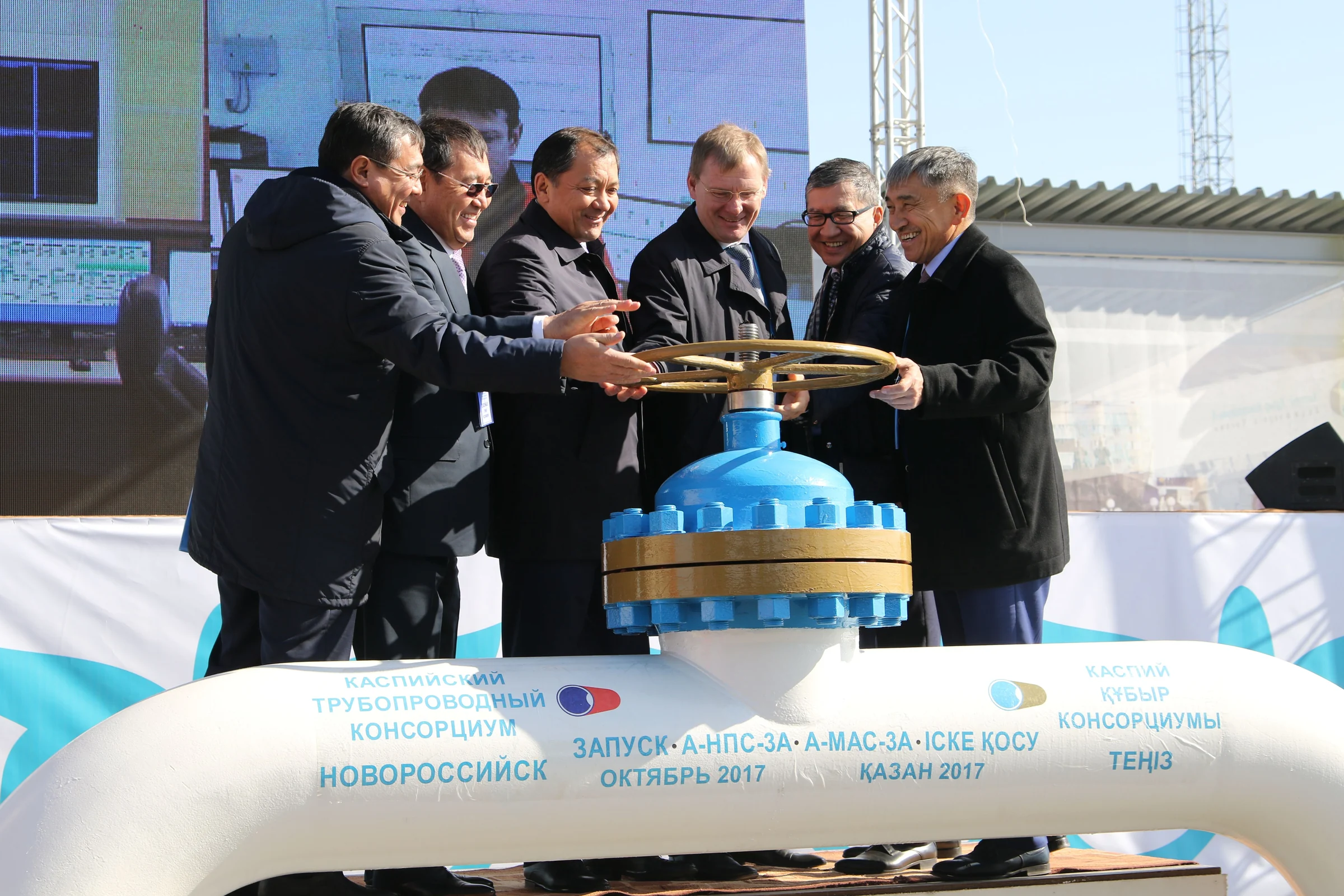
The CPC Pipeline Expansion Project was launched in 2011. Ten pump stations were built under the project, a third SPM was installed in the Marine Terminal water area, and the capacity of the tank farm near Novorossiysk was increased to one million tonnes.
The Expansion Project was successfully completed in 2018, increasing the oil pipeline’s throughput capacity to 67 million tonnes of crude oil per year. Two years earlier, in October 2016, crude oil from offshore fields began entering the CPC system: Kazakhstan’s Kashagan field, operated by CNOC, and Russia’s V. Filanovsky and Yu. Korchagin fields, operated by Lukoil.
It should be noted that the development of such major Kazakhstan fields as Karachaganak and Kashagan would not have been commercially viable without the CPC export oil pipeline and began only once the pipeline had been laid and had demonstrated in practice that its throughput capacity could be “upgraded.” If as recently as 1998 Tengiz crude was carried from Aktau to Baku in rail tank cars, 48 to a ferry, and if those tank cars travelled slowly to marine terminals from Batumi to Porvoo in Finland, how could anyone have contemplated developing new fields? Tengiz alone was enough to contend with...
Caspian and Trans-Caspian Routes
In 2012, Tengizchevroil LLP began implementing the Future Growth Project – Wellhead Pressure Management Project (FGP–WPMP), aimed at increasing the Tengiz field production rate to 40 million tonnes per year. In total, Chevron Corporation invested $45 billion in the project.
To handle the increased supply volumes, CPC began implementing the Debottlenecking Program in May 2019. Pumping processes were optimised; in particular, mainline pump units were equipped with variable-frequency drives. Instead of two lease automatic custody transfer systems, three such LACT systems were installed at the Marine Terminal, enabling tankers to be loaded simultaneously from three SPMs. As a result, the CPC oil pipeline’s throughput capacity had increased to 83 million tonnes per year by the end of 2022. In 2025, CPC set a new annual lifting record of 70.5 million tonnes.
In September of that same year, 2025, CPC lifted the billionth tonne of oil since it began operations. Lined up, the rail tank cars needed to carry that volume would circle the Earth five times at the equator; shipping it by Aframax- and Suezmax-class tankers would require more than 9,500 vessels.
Under current geopolitical conditions, maintaining alternative import and export routes is becoming important for many countries. China, the UAE, and Kazakhstan are all doing so today. For example, in 2025, around 7 million tonnes of Tengiz crude were shipped not through the CPC system but via the Baku–Tbilisi–Ceyhan oil pipeline.
This 1,768-kilometre oil pipeline, which runs through Azerbaijan, Georgia, and Türkiye, transported 27.18 million tonnes of crude oil in 2025. On July 1, 2026, Azerbaijan’s state-owned company SOCAR became the operator of BTC, charging $120 per tonne for transit—three times the CPC transit tariff.
For crude oil from Tengiz, Karachaganak, and Kashagan to enter the BTC oil pipeline, it must cross the sea. The maximum throughput capacity of the oil terminal in Aktau is 5.2 million tonnes per year. Given the decline in the Caspian Sea level, it is becoming increasingly difficult for tankers to call there, and dredging works require money—a great deal of it. Optimising the Trans-Caspian route is among Kazakhstan’s national priorities. But this is no simple task, and the CPC oil pipeline therefore remains the most cost-effective and efficient route for transporting Kazakhstan’s crude oil for export today.
Social Commitment
It is important to understand that CPC itself owns neither the crude oil nor the tankers and therefore has no connection to the hundreds or even tens of billions of dollars mentioned above. At a tariff of $38 per tonne, CPC earns around two billion dollars annually and spends its profit on modernisation, environmental protection, charity, and dividends to shareholders.
The Consortium began paying dividends in 2020, after fully recouping its construction investment. As of 2026, CPC shareholders had received around $6.1 billion in dividends. Over the thirty years since the company began operating, CPC paid around 460 billion tenge in taxes into Kazakhstan’s national and regional budgets and spent more than 17 billion tenge on charity.
Over the years that CPC’s charitable programmes have been implemented, new schools, kindergartens, and medical facilities have been built in Atyrau and other communities in Atyrau Region. Ambulances, buses, and other vehicles are purchased. One of the largest projects in recent years is a 900-place school in the Talgairan neighbourhood of Atyrau.
In 2023, CPC-K JSC received the Republic of Kazakhstan’s state Paryz Award in the Best Socially Responsible Enterprise category.
CPC’s social and charitable activities in Russia are comparable in scale. Since the company began operations, it has paid more than 223.5 billion rubles in taxes to federal and regional budgets. Spending on CPC charitable programmes and projects in Russia over the company’s years of operation exceeds 10 billion rubles.
At the same time, the Consortium invests another 12% of its profit in environmental protection, in accordance with international rules for crude oil transporters. This includes both technologies that minimise the environmental impact of production facilities and programmes to restore rare wildlife species, including saiga antelopes, sturgeon and deer. The balance between CPC’s profit and its investment in the regions where it operates brings to mind a word that is far from popular today: “altruism.” At the same time, the 30-year history of this 1,511-kilometre system demonstrates the project’s commercial viability and continued relevance.